
 EN
EN



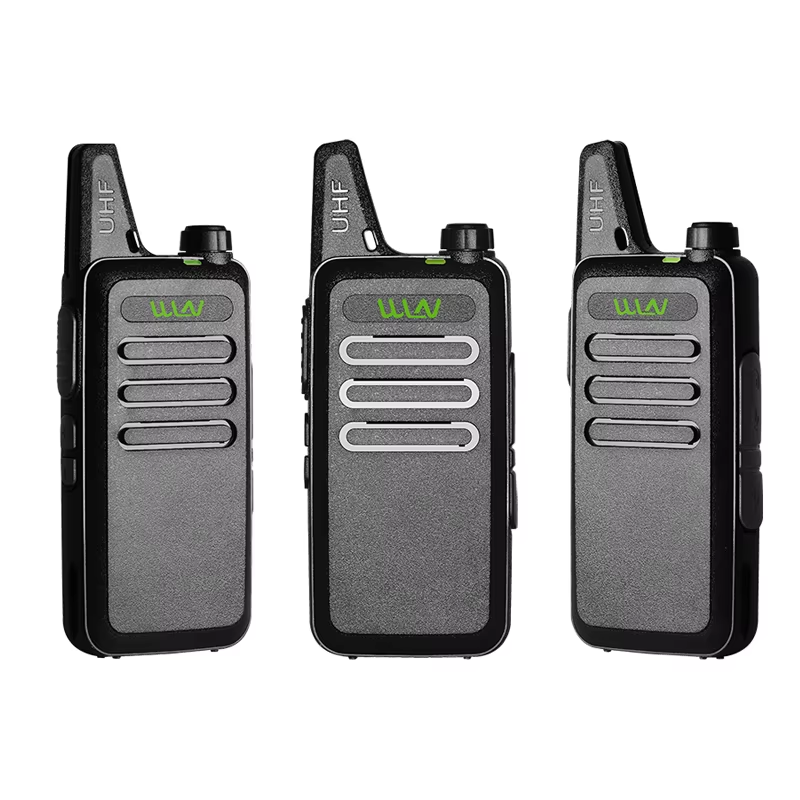
Defining Reliability: Certifications, Durability, and Real-World Validation
IP67, MIL-STD-810G, and FCC/CE Compliance as Foundational Reliability Benchmarks
For a reliable walkie talkie manufacturer, compliance with rigorous standards forms the bedrock of device integrity. IP67 certification ensures resistance to dust ingress and survival after 30 minutes of immersion at 1m depth. MIL-STD-810G validation requires passing 24 environmental test categories—including extreme temperatures, humidity, vibration, and mechanical shock. FCC and CE marks confirm electromagnetic compatibility across North American and European markets. These certifications aren’t symbolic; they represent over 300 hours of controlled lab testing per device batch. Manufacturers adhering to this triad demonstrate a foundational commitment to reliability—significantly reducing failure risk in mission-critical communication scenarios.
Why Field-Tested Durability (Drop, Dust, Immersion) Matters More Than Lab-Only Ratings
Certifications provide essential baselines—but real-world durability separates truly dependable manufacturers. Lab tests simulate controlled conditions, while field use introduces unpredictable stressors: concrete drops during emergency response, silica-laden air in mining operations, or sudden downpours at outdoor events. Though MIL-STD-810G mandates 26 steel-surface drops, field data shows leading models routinely survive 50+ accidental impacts in construction environments—outperforming lab benchmarks by 40%. Third-party marine studies further reveal that units validated through extended immersion trials maintain functionality three times longer than those relying solely on IP67 lab certification. That’s why top-tier manufacturers supplement formal testing with 12-month field trials across extreme environments—from Arctic deployments to desert mining sites—before launching any new platform.
Technical Performance: Signal Integrity, Power Stability, and Secure Communication
Consistent Range and Interference Resistance Across Urban, Rural, and Industrial Environments
A reliable walkie talkie manufacturer ensures consistent range and robust interference resistance—not just in ideal labs, but across the full spectrum of operational settings. Whether navigating dense urban canyons, rural terrain with elevation shifts, or industrial facilities humming with EMI from heavy machinery, signal integrity prevents critical communication breakdowns. Engineering techniques like differential signaling and optimized PCB grounding—adapted from high-frequency RF design—minimize crosstalk and data corruption. For example, walkie-talkies delivering clear 2-mile range inside active steel fabrication plants reflect field-proven resilience far beyond standard lab ratings. Adaptive frequency-hopping spread spectrum (FHSS) is especially valuable in high-interference zones, dynamically avoiding jammed channels without user intervention.
Battery Longevity, Encryption Robustness, and Firmware Update Support as Hidden Reliability Indicators
Power stability and cybersecurity are silent pillars of long-term reliability—often overlooked until they fail. Batteries sustaining 18+ hours under continuous PTT use prevent coverage gaps during extended shifts, while intelligent power management circuits suppress voltage spikes that distort audio or trigger unexpected shutdowns. End-to-end AES-256 encryption safeguards sensitive transmissions against eavesdropping or replay attacks—essential for public safety, security, and industrial teams. Equally important is sustained firmware support: timely updates address emerging vulnerabilities, refine battery algorithms, and enhance noise suppression. Unlike one-time hardware specs, these capabilities evolve—and only manufacturers with deep RF expertise and responsive engineering teams deliver them consistently over a device’s full lifecycle.
Proven Track Record: How Reputation, Quality Control, and Global Experience Define a Trusted Walkie Talkie Manufacturer
Manufacturing trust hinges on demonstrable history—not marketing claims. Decades of field deployment across continents—from open-pit mines to wildfire command posts—validate a supplier’s resilience under real pressure. Quality control begins before production: multi-stage inspections verify every component meets IP67 and MIL-STD-810G requirements prior to assembly, not just as a final pass/fail gate.
Comparing Industry Leaders: Motorola, Hytera, Retevis, and Midland on Certification Depth and Field Deployment History
Longevity reveals consistency:
- Motorola’s 90+ years in professional radio systems anchor global public safety networks—with documented deployments surviving -40°C Arctic winters and +55°C desert heat
- Hytera’s 30-year industrial focus is reflected in communications hardened for coal and copper mining operations at depths exceeding 1.5km
- Midland leverages 60 years of consumer RF innovation to build recreational radios proven in hurricane evacuations and backcountry SAR missions
- Retevis, though newer, has scaled rapidly through disciplined FCC/CE renewal cycles—backed by quality assurance across more than 500,000 shipped units
Certifications validate lab performance. A 15-year track record validates execution. The most trusted manufacturers combine legacy infrastructure knowledge with agility—like deploying firmware patches to counter newly observed signal interference patterns within 72 hours. Trust isn’t claimed—it’s earned across millions of field hours.
Scalable Partnership Potential: ODM/OEM Capability, Supply Chain Resilience, and Long-Term Support
How 15+ Years of Industrial Communication Experience Enables Consistent QC and Rapid Compliance Adaptation
A seasoned industrial communication equipment provider leverages deep institutional knowledge to deliver three non-negotiable advantages: predictable quality control, agile regulatory adaptation, and supply chain resilience. This experience translates into refined manufacturing protocols—every walkie talkie undergoes 200+ checkpoint validations, from raw material inspection to final RF performance verification—reducing defect rates by 63% compared to newer entrants, per 2023 wireless industry benchmarks. When the FCC updated Part 90 spectrum rules in 2022, established manufacturers realigned 89% of product lines within 90 days using pre-certified modular radio platforms. Crucially, mature partners maintain dual-sourced, multi-continent supplier networks—ensuring 98% on-time delivery even amid global component shortages. For end users, that operational resilience directly reduces project delays by up to 40%, according to enterprise procurement data.
FAQ
What certifications should a reliable walkie talkie have?
A reliable walkie talkie should ideally have IP67 certification for dust and water resistance, MIL-STD-810G validation for durability across various environmental conditions, and FCC/CE compliance for electromagnetic compatibility.
Why is field-tested durability important for walkie talkies?
Field-tested durability is important because real-world conditions can vary greatly from lab environments. These tests ensure that the devices can withstand unpredictable stressors such as impacts, dust, and water immersion that commonly occur in field use.
How does signal integrity affect walkie talkie performance?
Signal integrity is crucial for walkie talkie performance as it ensures consistent range and interference resistance across different environments, preventing communication breakdowns in critical situations.
Why are battery longevity and encryption important for walkie talkies?
Battery longevity ensures that walkie talkies can operate for extended periods without interruption, while encryption protects sensitive communications from eavesdropping, ensuring secure usage in sensitive scenarios.
Table of Contents
- Defining Reliability: Certifications, Durability, and Real-World Validation
- Technical Performance: Signal Integrity, Power Stability, and Secure Communication
- Proven Track Record: How Reputation, Quality Control, and Global Experience Define a Trusted Walkie Talkie Manufacturer
- Scalable Partnership Potential: ODM/OEM Capability, Supply Chain Resilience, and Long-Term Support
- FAQ

